

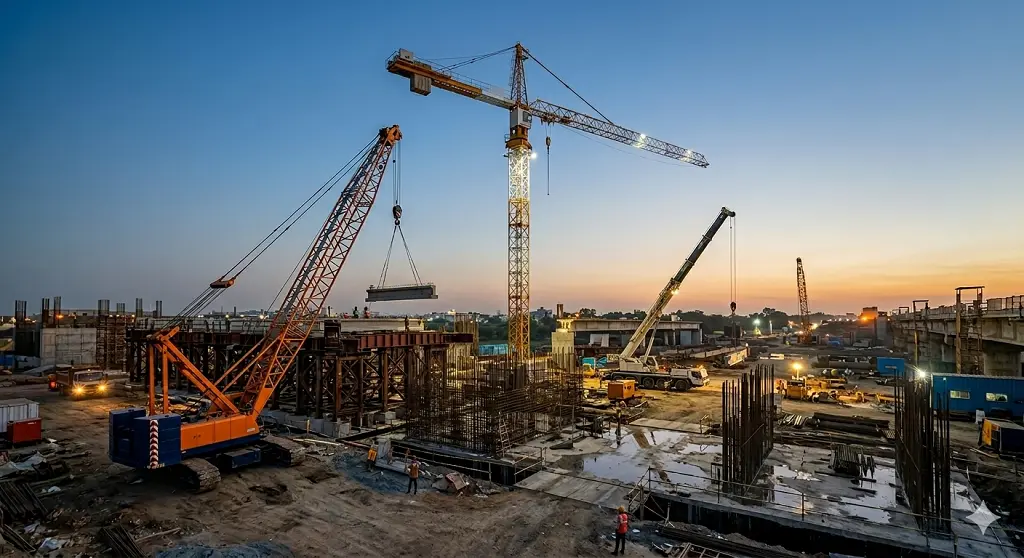
Construction cranes are essential heavy-lifting machines designed to move materials horizontally and vertically using a combination of wires, chains, and sheaves. These mechanical assets are categorized by their mobility, boom type, and lifting capacity ranging from 10-ton utility units to 3,000-ton heavy-lift giants. Selecting the correct crane is a critical engineering decision that directly impacts the safety, timeline, and cost-efficiency of infrastructure and industrial projects.
The Engineering Behind Heavy Lifting: A Professional Overview
In the heavy lifting industry, a crane is more than just a tool; it is a calculated response to a physics problem. As the founder of Sanghvi Movers Limited, I have overseen thousands of deployments where the difference between a successful lift and a project delay was the nuance in equipment selection. Modern construction demands high-precision assets that can navigate restricted urban spaces or withstand the harsh terrain of a wind farm.
Effective crane management relies on understanding the load chart, which dictates the maximum weight a crane can lift at various radii and angles. Utilizing the wrong asset not only risks structural failure but also compromises the Logistics & Transport efficiency of the entire site.
1. Mobile Cranes: The Versatile Workhorse
Mobile cranes are defined by their ability to travel on roads and set up quickly without the need for extensive foundation work. They are the primary choice for infrastructure projects and quick-turnaround industrial maintenance.
All Terrain Crane
An All Terrain crane is a hybrid powerhouse designed to drive at highway speeds while maintaining the ability to navigate off-road job sites. Featuring multi-axle steering and high-pressure hydraulic crane systems, these units provide lifting capacities from 50 to 1,200 tons. They are the preferred crane for industrial projects due to their rapid deployment and compact footprint.
Rough Terrain Crane
Specifically engineered for off-road applications, the Rough Terrain crane features oversized tires and a low center of gravity. While they are not road-legal for highways, they are the standard types of cranes used in road construction and early-stage bridge work where ground conditions are unstable.
Pick and Carry
The Pick and Carry crane is a specialized utility unit designed to lift a load and travel with it. These are essential for material handling in confined spaces, such as factory interiors or crowded logistics hubs.

2. Crawler Cranes: Stability for Massive Loads
When a project requires maximum lifting capacity and the ability to move while under load, the Crawler crane is the undisputed leader.
Lattice Boom Crane
The Lattice Boom crane utilizes a lightweight, high-strength steel framework instead of a telescopic arm. This design allows for significantly higher capacities at greater heights. It is the gold-standard crane for wind turbine installation, where massive nacelles and blades must be hoisted to extreme elevations.
On-Track Mobility
Mounted on a pair of tracks (crawlers), these machines distribute weight over a large surface area, preventing them from sinking into soft soil. Because they do not require outriggers for stability, they can “creep” with a full load, making them vital for crane for bridge construction and large-scale refinery setups.

3. Tower Cranes: The High-Rise Specialists
The Tower crane is the defining feature of modern skylines. As the dedicated crane for high-rise construction, these machines are often fixed to a concrete pad or “climbed” alongside the building as it rises.
- Slewing Reach: They offer the best horizontal reach (jib) in the industry.
- Static Precision: While stationary, they provide unmatched precision for placing steel beams or concrete buckets at heights exceeding 500 meters.
Crane Comparison: Capacity & Application Table
| Crane Type | Mobility Level | Max Lifting Capacity (Typical) | Primary Use Case |
| All Terrain | High (Road & Off-road) | 50t – 1,200t | Industrial Maintenance, Infrastructure |
| Crawler | Low (On-site tracks) | 50t – 3,000t | Wind Power, Refineries, Bridges |
| Tower Crane | None (Stationary) | 8t – 64t | High-Rise Buildings, Urban Density |
| Rough Terrain | Medium (Off-road only) | 30t – 150t | Road Construction, Dam Projects |
| Pick and Carry | High (Internal Site) | 10t – 30t | Logistics, Material Handling |
Strategic Selection: Which Crane is Best for Building Construction?
Determining which crane is best for building construction depends on the project’s verticality and site footprint. For high-density urban residential towers, a Tower crane is mandatory to clear neighboring structures. However, for sprawling commercial complexes or “mid-rise” developments, a fleet of All Terrain or Hydraulic cranes is often more cost-effective because they do not require permanent foundations and can be demobilized the moment their task is complete.
For road construction, the selection shifts toward mobility. Contractors typically utilize Rough Terrain cranes for clearing and Lattice Boom crawlers for placing heavy bridge girders.

Key Takeaways for Project Managers
- Prioritize the Load Chart: Never estimate capacity; always consult the manufacturer’s load chart for specific boom angles.
- Ground Bearing Pressure: Ensure the site can support the weight of a crawler or the outrigger pressure of a mobile crane.
- Wind Speed Limits: High-reach cranes, especially in wind turbine installation, have strict operational wind-speed thresholds to prevent tipping.
Frequently Asked Questions (FAQ)
- What are the common types of cranes used in road construction?
Road construction primarily utilizes All Terrain cranes for their mobility and Rough Terrain cranes for their ability to navigate unpaved paths. For bridge segments, Lattice Boom Crawlers are often used due to their high lifting capacity.
- Which crane is best for building construction in tight urban spaces?
The Tower crane is the most effective for urban high-rise projects because it occupies a very small ground footprint while providing a massive 360-degree working radius at height.
- What is the difference between a Hydraulic crane and a Lattice crane?
A Hydraulic crane uses a telescopic boom that can extend or retract quickly. A Lattice crane uses a fixed steel framework that must be assembled; it is generally stronger and can reach greater heights, making it ideal for industrial and wind power projects.
- How do I determine the lifting capacity needed for my project?
Lifting capacity is determined by the “Load Radius” the distance from the center of the crane to the load. You must calculate the weight of the object, the rigging gear, and the height it needs to reach to select the correct crane from a load chart.
- Why are Crawler cranes used for wind turbine installation?
Wind turbines require lifting heavy nacelles to great heights. Crawler cranes provide the necessary stability and high-capacity lattice booms to reach those heights while staying mobile on the uneven terrain typical of wind farms.
Empower Your Construction with India’s Lifting Leader
At Sanghvi Movers Limited, we specialize in providing the muscle and the mind behind India’s most iconic structures. From urban flyovers to massive power plants, our fleet of mobile cranes represents the pinnacle of lifting technology. We offer more than just machinery; we provide integrated Crane Rentals, EPC Solutions, and Logistics & Transport services to ensure your project is executed with precision, safety, and speed.
Contact our technical team today to find the perfect mobile lifting solution for your next project.